PL
PL 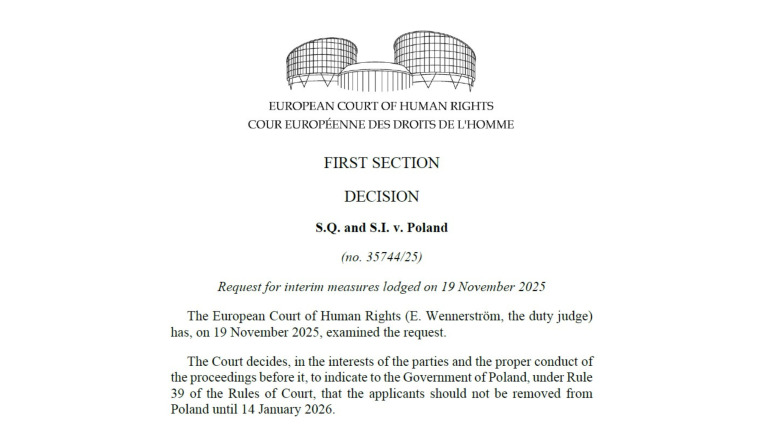

What are interim measures?
Interim measures, pl. środki tymczasowe are the emergency instruments available to the European Court of Human Rights under specific circumstances, when there exists a real, serious risk of irreversible damage to one's rights which are protected by the European Convention on Human Rights. Their purpose is the prevention of violations, which due to their nature would be impossible to rectify on a later date – either through damages, restoration to the previous conditions or other compensatory measures.
Many applications to the Court come from those individuals who have not been given the opportunity to appeal against negative decisions on state level.
A decision on the application of interim measures usually has a precautionary and procedural character. They are not meant to signify whether a decision taken by national authorities is correct or permissible, eg. in a border case regarding pushbacks, in the case of a positive review of the application for interim measures, Polish authorities are obliged to allow entry of the individual into the country in order to apply for international protection, but it doesn's ensure that the individual will receive protection later down the line. Every case is reviewed on an individual basis, urgently and with full understanding of individual circumstances of the case in question.
The extent and nature of applicable measures
In practice, interim measures are rather rare and introduced in only the most specific cases. Such cases are most often related to individuals who are under a threat of removal, deportation or extradition by state authorities and there exists a risk for their fundamental rights to be violated. Interim measures will usually focus on suspending a decision on removal or extradition until the Court has concluded its substantive review of a complaint.
The most common legal provisions on the basis of which interim measures are applied:
- art. 2 ECHR – the right to life
- art. 3 ECHR – prohibition of torture and inhumane or degrading treatment
When there exists a possibility that a decision taken by state authorities will result in a breach of either of these rights, the Court may instruct them to halt their activites until further analysis of the case has been concluded.
Occassionally, interim measures may be introduced in cases related to:
- art. 6 ECHR – the right to a fair trial,
- art. 8 ECHR – the right to respect for private and family life,
eg. when there exists a risk of permanent damage to family cohesion.
The Court stresses that the applicants are obliged to indicate concrete, actual and serious danger of irreparable damage and provide relevant evidence that will show credibility of the claims to a sufficient extent.
Who can apply for interim measures?
Due to its nature as an application-based procedure, whether the procedure is successfuly initiated depends mostly on making an application on a correct template.
An application for interim measures can be made by:
- parties of an ongoing legal procedure or one planned before the ECHR,
- other persons that display an interest in the case,
- in the cases related to minors - parents, legal guardians, the minors themselves or a prosecutor.
The application is made directly to the ECHR, usually online, and should include a description of the risk and relevant documents which prove that there exists a real and direct threat to one's fundamental rights (see: https://r39.echr.coe.int).
Deadlines for application
The law does not set a strict time limit for one to apply to introduce interim measures in their case. It's possible to apply at any point of the legal proceedings - both during administrative procedure and after it came to a close. The application should be deliberated upon on the same day that it was obtained, if the application was made before 16:00 (GMT+1). The decision of the ECHR does not contain an explanation and it cannot be appealed against.
Our practice (Rule of Law Institute)
In our practice, we often prepare applications for the introduction of interim measures in the cases of foreigners who are experiencing especially sensitive circumstances or belonging to vulnerable groups.
They are especially relevant in regard to those migrants who pass through the Polish-Belarusian border and declare a desire to apply for international protection but are in danger of an immediate expulsion, a so called pushback. Also in the cases when the Border Guard refuses to accept an international protection application despite a clear declaration of desire to apply displayed by the foreigner. Such situations make migrants vulnerable to removal from the territory of the state without having their individual circumstances investigated - a practice that has been the object of our and international interventions in the past.
Our activities were described in detail here: https://www.linkedin.com/pulse/frontex-v-poland-has-eu-stopped-funding-unlawful-from-tomasz-sieniow-lgmof/
A quick action of the ECHR and a directi influence on state authorities can often be the only effective instrument allowing for prevention of expulsion of a foreigner and providing them with real access to the international protection procedure.
Bibliography:
- chrome-extension://efaidnbmnnnibpcajpcglclefindmkaj/https://www.echr.coe.int/documents/d/echr/Interim_Measures_POL